
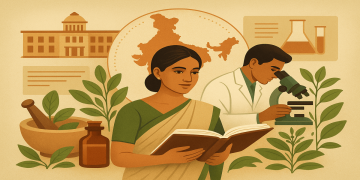








India, the birthplace of Ayurveda, is globally recognised for offering a wide spectrum of courses designed to produce skilled professionals in medical, pharmaceutical, yogic, and allied health sciences. These programmes operate under the AYUSH umbrella and are managed by both state and central government agencies, with robust regulatory bodies such as the National Commission for Indian System of Medicine (NCISM) ensuring quality education in medical streams like BAMS and MD (Ayurveda). States such as Gujarat, Punjab, Himachal Pradesh, and Uttar Pradesh provide registration for Ayurvedic pharmacists who have pursued Diploma in Pharmacy (Ayurveda), B Pharmacy (Ayurveda), or M Pharmacy (Ayurveda) as a career, under strict regulatory oversight. Additionally, allied health and YOG courses are also governed by national and state authorities.

Institutions Leading the Way
Several prestigious institutions have become pillars of Ayurvedic education. The Institute of Teaching and Research in Ayurveda (ITRA), an institute of national importance, and Gujarat Ayurvedic University in Jamnagar, Gujarat, are pioneers in medical, pharmaceutical, and allied health disciplines. Other notable names include Banaras Hindu University (BHU), which offers comprehensive programmes in medical, pharmaceutical, and allied Ayurvedic sciences, and the National Institute of Ayurveda (NIA), a Deemed-to-be University (De Novo), which provides advanced education in medical and allied health courses of Ayurveda.
Private institutions are also making significant contributions. Lovely Professional University (LPU), Punjab, has emerged as a leader in Ayurvedic pharmaceutical research, offering undergraduate, postgraduate, and doctoral programmes that integrate modern technology with traditional wisdom. The university has produced a substantial number of intellectual property rights (IPRs) and research publications in reputed Scopus-indexed (Q1, Q2) and Web of Science journals. Additionally, the university has developed curricula for pharmaceutical education that meet cutting-edge requirements and align with global standards.
The Government of India has also established premier centres such as the All-India Institute of Ayurveda (AIIA) to promote research in clinical and paramedical fields. Despite these developments, the number of globally benchmarked institutions in this sector remains limited. However, within India, numerous universities, colleges, and boards offer a wide range of medical and other Ayurvedic education programmes.
A Booming Global Market
The global demand for natural and plant-based medicines is surging. According to Fortune Business Insights, the global herbal medicine market was valued at USD 233.08 billion in 2024 and is projected to grow from USD 251.25 billion in 2025 to USD 437 billion by 2032, at a CAGR of 8.23%. This indicates immense opportunities for Ayurveda and herbal medicine worldwide.
India is well positioned to leverage this demand, given its rich diversity of medicinal flora and a strong healthcare infrastructure comprising PHCs, CHCs, and a network of government and private hospitals. The country is also home to leading Ayurvedic and FMCG manufacturing companies. Yet, despite these advantages, challenges persist for Ayurvedic scholars seeking global acceptance.
The Critical Gaps
While India has strengthened medical education policies and expanded the number of institutions, Ayurveda’s rich heritage—encompassing classical literature, documented clinical knowledge, pharmaceutical formulations, dietary and nutritional principles, and allied health practices—still lacks adequate support in pharmaceutical education. There is an urgent need for a greater number of specialised pharmaceutical institutions and a comprehensive national education policy focused on Ayurvedic pharmaceutical education.
Currently, this sector has not received the same level of attention as medical education, despite the growing demand for highly skilled professionals, particularly in developing safe, effective, and clinically accepted medicines. The most pressing challenge is the lack of stringent quality control and clinical validation in Ayurvedic medicine production, which is essential for achieving international credibility.
Experts emphasise the need to harmonise pharmaceutical education and regulatory practices across the country, as only a few institutions—such as ITRA, Jamnagar; Lovely Professional University; and BHU—currently provide world-class training in this field.
What Needs to Change?
To make Ayurvedic education globally competitive and enhance the acceptance of Ayurvedic medicines worldwide, experts recommend the following steps:
- Curriculum reforms across medical, pharmaceutical, and allied health education.
- Industry–academia partnerships for practical exposure and innovation.
- Scientific validation of classical medicines through rigorous clinical research.
- International regulatory compliance to ensure global market readiness.
- Development of novel drug delivery systems with proven safety and efficacy.
- Safety assurance as per global norms for Ayurvedic medicines.
- Cross-disciplinary collaboration integrating modern pharmaceutical technology with Ayurvedic principles in medicine and pharmaceuticals.
- International exchange programmes to align with global healthcare standards.
- Establishment of world-class Ayurvedic medical institutes with strong pharmaceutical wings at national and global levels.
- Robust national regulations to standardise and enhance all forms of Ayurvedic education.
- Integration of AI and digital tools into education and research for greater innovation.
- Strong focus on translational research and a higher number of IPRs for Ayurvedic drugs.
- Redesigning dosage forms with clinical validation.
- Quality publications in Scopus and Web of Science.
India stands at a pivotal juncture. With its deep-rooted tradition and a booming global market for herbal and Ayurvedic medicines, the potential is enormous. However, realising this potential requires strategic reforms, globally benchmarked pharmaceutical and medical education, and strong government–industry–academia collaboration. By addressing these gaps, India can ensure its Ayurvedic scholars and professionals achieve true global competence while preserving the essence of this ancient science